
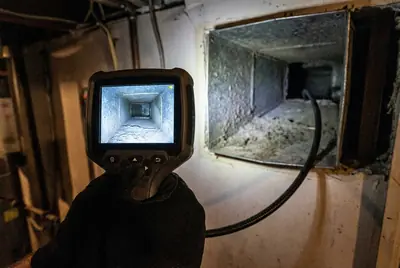
Duct camera inspections
A recorded pass through supply and return trunks, with findings you can watch rather than take on faith.
Offices, storefronts, clinics and classrooms in Garden Grove and the rest of Hillsborough County get their ductwork inspected on camera, cleaned overnight and documented with photos.
Free, technical, and it ends in a written price that does not drift.
Tired of breathing funky air inside your business? Let's talk about making your workplace way more breathable and maybe even saving you some cash.
Ever walked into a shop or office and immediately thought, "Whoa, what's that smell?" You're not alone. That musty odor or that faint, lingering scent of… well, something you can't quite place, often originates from a place you never even see: your business's ventilation system. Think of it as the lungs of your establishment, constantly circulating air. Now, imagine if those lungs were clogged with dust, grime, and all sorts of unmentionable particles. That's where professional attention to your air pathways comes in, and it's a whole lot more important than most folks realize, especially in a vibrant area like Garden Grove.
You see, over time, your commercial air distribution network collects a cocktail of unwanted guests. Dust bunnies the size of small rodents, pet dander if you have a pet-friendly establishment, pollen that drifts in from the beautiful Florida outdoors, even microscopic mold spores can take up residence. This buildup doesn't just smell bad; it actively degrades the air quality you and your employees, and importantly, your customers, are breathing every single day. This can lead to a host of issues, from general grogginess and stuffy noses to more noticeable problems that impact productivity and the overall atmosphere.
This invisible accumulation can really impact the vibe of your business. Imagine a customer walking in, ready to spend some money, only to be hit with a wave of stale air. It's not exactly the recipe for a memorable, positive experience, is it? It might subtly make them want to leave sooner or even deter them from returning. On top of that, when your air distribution system is working overtime to push air through all that gunk, it's essentially straining itself. This extra effort translates directly into higher energy bills, as your HVAC system has to work much harder to achieve the desired airflow. It's a double whammy: poor air quality and wasted money.
So, what exactly are these sneaky culprits hiding in your air pathways? Well, for starters, there's the obvious: dust. Everywhere dust goes, it settles. Then, as air moves, it picks up more and more of it, depositing it in every nook and cranny of your ventilation. On top of that, think about the seasons here in Florida. Pollen counts can be through the roof, and much of that finds its way into your building's air intake. If you have any furry friends working alongside you or visiting your establishment, their dander becomes another contributor to the mess.
But it gets a little more complex than just dust and pollen. Over time, moisture can also become an issue within the ductwork. This creates a breeding ground for more unwelcome microscopic organisms like bacteria and mold. These aren't just unsightly; they can release spores into the air you breathe, which is certainly not ideal for anyone's respiratory system. This is especially a concern in areas with humidity, like parts of the Sunshine State, where even small amounts of condensation can become a problem if not addressed.
Furthermore, consider the general wear and tear of a commercial building. Little bits of insulation, construction debris from past renovations, even small insects or their remnants can find their way into the system. All these things contribute to the overall contamination load. When your system is running, it's essentially acting as a giant fan, blowing all these particles around your workspace. This means that even if you're diligent about cleaning floors and surfaces, you're still dealing with a constant barrage of airborne contaminants.
Let's move beyond just the unpleasant odors for a moment, though those alone are reason enough for many to seek a solution. The real impact of neglected air distribution pathways runs much deeper, affecting everything from employee well-being to your bottom line. When the air is thick with contaminants, it can lead to what many people call "sick building syndrome." This isn't a formal medical diagnosis, but it describes a collection of symptoms people experience when they're in a particular building.
Think about it: employees might complain of headaches, fatigue, difficulty concentrating, or even experience more frequent allergy flare-ups. This isn't just about feeling a bit under the weather; it directly impacts productivity. When your team isn't feeling their best, they can't perform at their peak. Deadlines might be missed, customer service could suffer, and overall efficiency drops. It's a silent drain on your business's potential, all because of something hidden away from view.
Moreover, the recurring need for employees to take sick days due to poor air quality can really add up. The cost of lost work hours, the potential need for temporary staff, and the impact on team morale when colleagues are frequently absent are all tangible financial hits. This is why investing in professional air pathway purification isn't just about making your business smell nice; it's a strategic move to create a healthier, more productive work environment for everyone involved. It's about safeguarding your most valuable asset: your people.
Now, let's talk about the sneaky financial consequences of not keeping those air pathways clean. As I mentioned earlier, a heavily contaminated system has to work harder. This increased strain on your HVAC units means they consume more electricity, directly leading to higher utility bills. It's like trying to breathe through a straw when your nose is stuffed up; you have to exert way more effort. That extra effort costs money, month after month.
Furthermore, this increased workload can put premature wear and tear on your HVAC equipment. Motors might overheat, fans could become strained, and other components could fail sooner than expected. This means you might be looking at costly repairs or even premature replacement of expensive machinery. The cost of a professional cleaning service is often a fraction of what it could cost to fix or replace a damaged HVAC system down the line. It's a classic case of an ounce of prevention being worth a pound of cure.
Also, consider the customer experience. A business that smells fresh and clean conveys professionalism and care. Conversely, a business with stale or unpleasant air might unintentionally signal a lack of attention to detail. This can influence customer perception and purchasing decisions. People want to spend their hard-earned money in places that feel welcoming and well-maintained, and that includes the very air they breathe. Don't let a hidden problem detract from the positive impression you work so hard to create.
Alright, so we've established that your business's air pathways are probably doing a lot more work than you realize, and that work can lead to some less-than-ideal situations. But here's the good news: there's a straightforward and effective solution. Bringing in skilled professionals who specialize in cleaning these vital systems can make a world of difference. They have the specialized tools and knowledge to get the job done right, far beyond what you could achieve with a simple vacuum cleaner.
Think of it this way: you wouldn't try to perform surgery with a butter knife, right? Similarly, cleaning the complex network of air pathways in a commercial building requires more than just household equipment. These experts utilize powerful, industrial-grade vacuum systems that create incredible suction to pull out deep-seated debris. They also employ specialized brushes and rotary tools that can reach into all the nooks and crannies, dislodging even the most stubborn buildup from the interior surfaces.
Their process often involves a thorough inspection to understand the unique layout of your system. They'll identify potential problem areas and tailor their cleaning approach accordingly. This ensures that every part of your ventilation, from the main trunk lines to the individual vents, receives the attention it needs. It's a comprehensive approach designed to restore your system to its optimal performance and cleanliness, giving you peace of mind and, more importantly, cleaner air.
Now, you might be wondering what the actual process looks like when the professionals come out. It's generally a non-disruptive procedure, designed to minimize any inconvenience to your daily operations, especially if your business is located in the lovely Garden Grove area. They'll typically start by sealing off the vents to contain the dust and debris that will be dislodged. This is a crucial step to prevent that mess from spreading throughout your workspace.
Following this, they'll use their specialized equipment to access the main air pathways. High-powered vacuums are connected to the system, and mechanical brushes are sent through the ducts to scrub the interior surfaces. This process effectively loosens all the accumulated gunk, the dust, the dander, the pollen, and whatever else has taken up residence over the years. The powerful suction then pulls all this loosened material out of your building, leaving the pathways remarkably clean.
On top of that, many professionals offer additional services. They might use specialized fogging treatments to sanitize the interior surfaces, eliminating any lingering bacteria or mold. They can also inspect your system for any minor issues, like loose connections or small leaks, which can further improve efficiency and air quality. It's a complete air pathway rejuvenation, leaving your system breathing freely again and your indoor air quality significantly improved.
So, what are the real, tangible benefits you'll notice after your commercial air pathways have been professionally cleaned? Well, the most immediate and noticeable change will likely be the improvement in your indoor air quality. That stale, musty odor will disappear, replaced by a fresh, clean scent. This creates a much more pleasant and inviting atmosphere for everyone who enters your business. It's a simple change that can have a profound impact on the overall perception of your establishment.
On top of that, you'll likely see a reduction in your energy bills. When your ventilation system can move air freely, it doesn't have to work as hard. This means it consumes less electricity, and you'll see that reflected on your monthly utility statements. This cost saving is a direct return on your investment in professional cleaning. It's a smart business move that pays for itself over time.
Furthermore, a clean air pathway system contributes to a healthier environment for your employees and customers. By removing the allergens, dust, and potential irritants, you can reduce instances of respiratory issues, allergy flare-ups, and general discomfort. This leads to a more productive workforce and happier patrons. It's about creating a space where people can thrive, breathe easy, and focus on what matters most, whether that's serving customers or getting work done efficiently in areas like Hillsborough County.
You might be thinking, "My air seems okay, I don't really need this right now." However, the buildup in your air pathways is often a gradual process. You get used to the subtle changes over time, making it hard to recognize how much the air quality has degraded. This slow accumulation means that by the time you notice a significant issue, the problem might be more extensive and costly to resolve.
Consider the cumulative effect of dust, dander, and moisture accumulating over months, or even years. This isn't just a surface-level issue; it can become deeply ingrained in the material of the ducts. The longer you wait, the more entrenched this buildup becomes, making it harder and more time-consuming for professionals to remove effectively. This increased difficulty can translate into higher cleaning costs.
Moreover, as we've discussed, a struggling ventilation system leads to increased energy consumption and potential wear and tear on your HVAC equipment. These are ongoing costs that chip away at your profits every single day you delay. Think of it as a leaky faucet; a small drip might not seem like much, but over time, it wastes a significant amount of water. The same principle applies to your air pathways and your energy bills.
Choosing to invest in professional commercial duct cleaning is a proactive step towards a healthier, more efficient, and more cost-effective business operation. It's about taking control of the unseen environment that significantly impacts your daily life and the experience of your customers. When you prioritize the cleanliness of your air pathways, you're investing in the well-being of your people and the long-term success of your establishment.
Imagine the peace of mind that comes with knowing your business is operating with the cleanest possible air. Picture your employees feeling more energized and focused, and your customers enjoying a refreshingly clean environment. This isn't just about aesthetics; it's about creating a foundational element of a thriving business. It's about demonstrating a commitment to quality that extends to every aspect of your operation, from the products or services you offer to the very air people breathe within your walls.
Ultimately, it's about making a smart, strategic decision that benefits everyone. It's a move that can improve employee morale, boost productivity, reduce operational costs, and enhance customer satisfaction. In a community like Garden Grove, where businesses strive to stand out, providing a superior indoor environment can be a significant differentiator. Don't let hidden contaminants hold your business back.
Ready to breathe easier and potentially save some money? A quick message can set you on the path to a cleaner, healthier, and more efficient workspace. Discover the difference professional attention to your air pathways can make.
A camera goes into the trunk lines first. What comes back decides everything: which runs carry real buildup, which only need their registers washed, and which are clean enough to leave alone. The findings are shown to you, not summarized at you, and if the honest answer is that your ducts do not need cleaning yet, that is what the visit concludes.
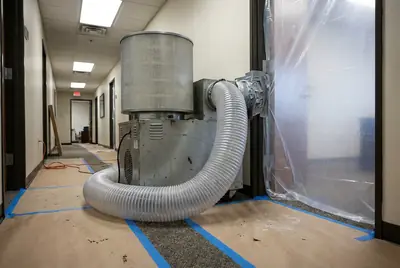
Before anything is loosened, the section under work is isolated and a vacuum collector is coupled to the duct so air moves toward the machine and nowhere else. Floors get covered, ceiling tiles get numbered, and the occupied side of the building keeps working with no idea we are there.
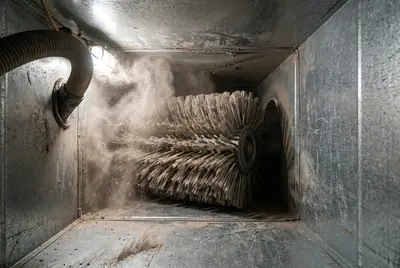
Rotary brushes and compressed air tools work down each run toward the collector, taking the buildup off the metal rather than pushing it deeper. The camera goes back in afterwards. If a stretch still shows residue, it gets done again before the access points are sealed and the registers go back on.
Some buildings need one misbehaving system dealt with. Others need the whole air side reset to zero. The table is the honest version of that choice.
Large sites are phased so no floor loses more than one night, and the same crew lead stays on the job from the first shift to the last photo.
A recorded pass through supply and return trunks, with findings you can watch rather than take on faith.
Rotary brushes and air whips sized to each duct, working the full length of every run toward the collector.
Vacuum units with fine filtration pull everything loosened straight out of the ductwork and off site.
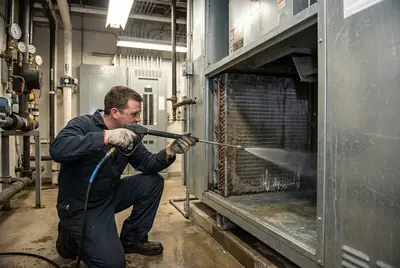
Blower wheels, plenum interiors and coils degreased and rinsed where the air actually picks up its speed.
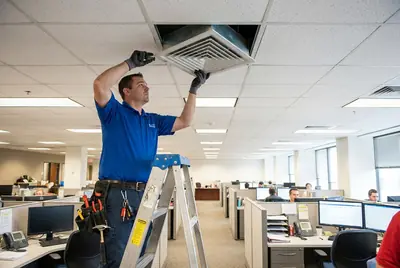
Every visible fitting comes off, gets washed and goes back straight, because occupants judge the job by what they can see.
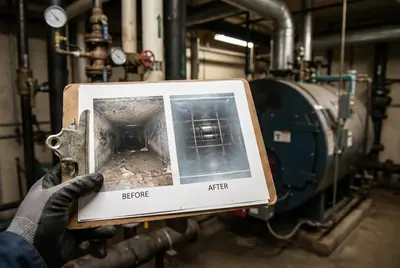
Before and after shots of each run and unit, labeled by floor, sent to whoever answers for the building.
It starts small. Gray fuzz on the desks two days after the janitorial pass. A smell like hot cardboard the first cold morning the heat comes on. A meeting room that feels used up twenty minutes into the hour. The person who sits under the same diffuser and swears the sniffles start on Monday and stop on Friday evening.
None of that proves the ductwork is dirty, and that is precisely why the camera goes in before any quote goes out. But when a building collects complaints of that shape, the supply and return runs are the one place nobody has looked, because nobody can without opening them. Years of drywall sanding, carpet fibers, kitchen aerosols and plain sediment ride the airstream and settle where the air slows down, and every startup of the fans stirs a little of it back over the people below.
After a proper cleaning, the change is undramatic and steady: filters load slower, the startup smell is gone, the dust cycle on the furniture stretches from days to weeks, and the complaints log goes quiet on the subject. Clean air does not announce itself. It just stops reminding people of the alternative.
Our estimator walks the building in Garden Grove with whoever knows it best, counts units and registers, lifts a few access panels and listens to what the occupants have been saying.
One document with the scope floor by floor, the night or weekend windows the work will use, and a figure that does not move once you sign it.
Drop cloths down, furniture sheeted where we pass, the first section isolated and coupled to the collector before a single fitting is opened.
Runs brushed to the collector, units and coils cleaned in place, each zone closed and its registers refitted before the crew moves on.
Access points sealed and labeled, the before and after file sent over, and a short note on anything worth budgeting for the years ahead.
Ceiling height, access hatches and how many years the system went untouched decide where inside these spans a building lands. The walkthrough turns them into one firm figure, and the walkthrough is free.
Containment is not a premium option. The section being cleaned is sealed and kept under suction toward the collector for as long as a tool is inside it, the collectors filter what they capture instead of relocating it, and the debris leaves in closed containers the same night. If a ceiling tile moved, it goes back. If a desk was sheeted, the sheet comes off and the desk looks exactly as its owner left it.
Proof beats promises. The camera footage from the inspection, the before and after photos of every run and the list of access points we cut and sealed all go to you, unedited. And when a run turns out not to need cleaning, the quote says so in writing, because a company that cleans ducts for a living should be the one telling you when yours are fine.
Almost never. The work is phased zone by zone during the hours you hand us, usually nights and weekends around Garden Grove, and each zone is finished, resealed and back in service before occupants return. Most tenants learn the ducts were cleaned from the memo, not from anything they saw.
By never letting it into them. The section under work is isolated and held under suction toward the collector, so loosened debris travels into the machine and not into the room. Floors and furniture along the route are covered anyway, because equipment gets carried through and belt and braces is the right dress code indoors.
With a camera, before any price is written. Buildup on the duct wall is either there or it is not, and you see the footage yourself. When an inspection finds runs that are still serviceable, the quote says so and shrinks accordingly.
Yes, and we would rather not skip them. The unit is where the air picks up speed, moisture and heat, so a spotless duct behind a dirty blower wheel is a job half done. Interiors, wheels, drain pans and coils are cleaned in place as part of a full building scope.
The dining room, the restrooms and the comfort systems are all standard scope. The grease exhaust over the cooking line is a different trade with different tooling, so it is priced separately at the walkthrough once we have seen the hood and the riser, and we tell you plainly if it needs a specialist instead.
A photo file with before and after shots of every run and unit, labeled by floor, plus the inspection footage and a note on the access points we added and sealed. It is the file you show an owner, an insurer or the tenant who asked, without needing us in the room.
Zoom for the lay of the land; the link lists further down name every community we book walkthroughs in from here.
Somewhere above these ceilings there is ductwork nobody has seen in years.
Book the walkthrough